
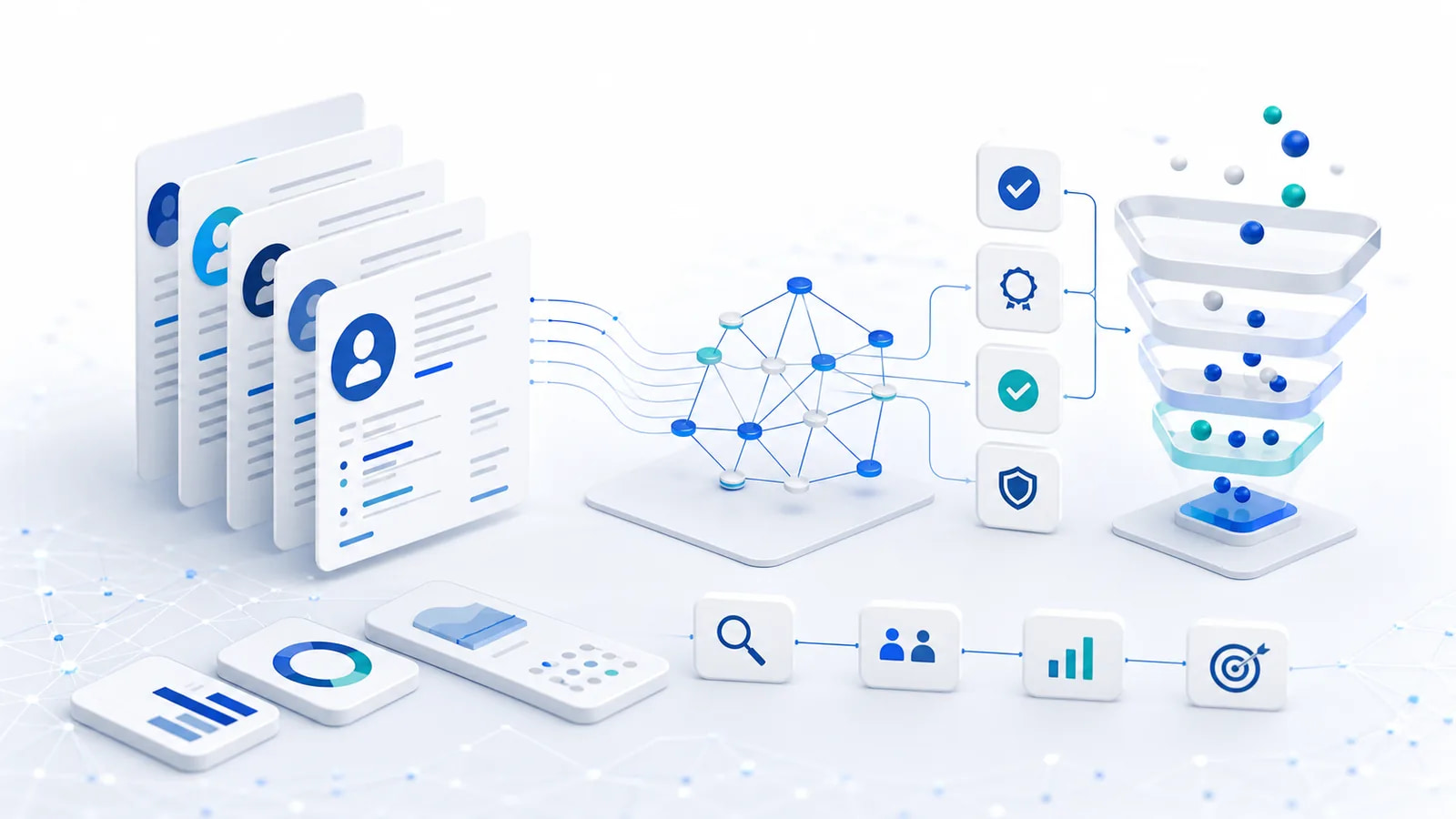
Something quietly broke in corporate hiring over the last eighteen months, and in 2026 the evidence finally caught up with the intuition. Recruiters had long suspected that the polished résumés flooding their inboxes and the flawless answers delivered in video interviews no longer told them much about the people behind them. Now the research confirms it. Harvard Business Review's June 2026 analysis, built on interviews with 120 talent-acquisition leaders and a review of more than 6,300 recorded screening sessions, reached a blunt conclusion: generative AI has undermined the reliability of the traditional signals hiring has depended on for decades. The ability to present a perfect résumé and deliver structured, confident interview answers — once a meaningful differentiator — has become, in HBR's framing, infinitely scalable and essentially free.
That single shift explains almost every major recruitment trend of 2026. When the old proxies for competence stop working, everything downstream has to change: how companies screen, what they measure, which technologies they buy, and how regulators respond. This article walks through the five forces reshaping modern recruitment this year, drawing on Deloitte's 2026 Global Human Capital Trends research, Harvard Business Review, Robert Half, and SHRM.
TREND 01 — The AI résumé flood — and the verification crisis it created
The most visible change is volume. AI writing tools have collapsed the cost of applying for a job to nearly zero, and candidates have responded rationally: they apply to everything, with documents tailored by machine to every posting. The irony is that this is hurting candidates and employers alike. A 2026 Robert Half survey of hiring managers found that 67% say AI-generated applications are actually slowing the hiring process down, and 65% report that skills have become harder to verify in AI-optimized résumés. Roughly one in five managers reported hiring delays of around two weeks directly attributable to the flood.
The problem goes beyond embellishment. Deloitte's 2026 Global Human Capital Trends report warns that deepfake interviews and AI-written résumés are eroding hiring signals recruiters have relied on for decades, and that verification is becoming a core recruiting skill in its own right — as fundamental as sourcing. Meanwhile, the screening tools bought to manage the volume have their own consistency problem: industry testing flagged by recruitment analyst Greg Savage found only 14% overlap in shortlists when the same AI screening tool was run twice on identical candidate data. When both sides of the funnel are automated and neither side fully trusts the output, the result is a hiring process that is faster on paper and slower in reality.
TREND 02 — From point solutions to agentic AI pipelines
If 2024 and 2025 were the years of AI point solutions — a résumé parser here, a scheduling bot there — 2026 is the year those pieces fused into something more ambitious. Deloitte's 2026 Global Human Capital Trends report, based on a survey of more than 9,000 business and HR leaders across 89 countries, describes agentic AI systems that now manage entire candidate pipelines end to end, with autonomous agents that know when to act and when to hand off to a human. Deloitte's talent acquisition technology outlook calls this a defining tipping point: organizations must make a deliberate leap from ad hoc AI adoption to intentional AI design, or risk falling measurably behind on hiring velocity, quality of hire, and cost per hire.
The gap between ambition and execution, however, remains enormous. The same Deloitte research reveals a striking disconnect: 66% of C-suite leaders acknowledge that traditional functions like talent acquisition must fundamentally change to stay competitive, yet only 7% report meaningful progress toward that change. For recruiting teams that do make the leap, the payoff is concrete. Practitioners describe building what amounts to a digital teammate — an "AI twin" that quietly handles sourcing, scheduling, follow-ups, and pipeline hygiene in the background — with firms reporting an estimated fifteen or more hours per week returned to each recruiter for genuinely human work.
"66% of C-suite leaders say traditional functions must fundamentally change to remain competitive. Only 7% report meaningful progress."
TREND 03 — Skills-based hiring becomes the new source of truth
When résumés can no longer be trusted, organizations need a different unit of measurement — and in 2026 that unit is the verified skill. Deloitte's research finds that 95% of executives are concerned about the quality of the candidate skills and capability data they rely on, which helps explain the accelerating shift away from degree requirements and job-title pedigree toward demonstrated ability. Skills-based hiring is no longer an experiment run by progressive tech companies; it is becoming the default architecture of talent acquisition, supported by structured assessments, work samples, and talent-intelligence platforms that map what people can actually do.
Harvard Business Review's prescription for the broken-signals problem points in the same direction. If polished self-presentation is now free and fakeable, the fix is to measure the work itself: live problem-solving, supervised work samples, structured evaluations tied to the real demands of the role, and reference points that AI cannot ghost-write. HBR researcher Tomas Chamorro-Premuzic, writing in a January 2026 HBR piece, argues that AI's net effect on hiring depends entirely on how it is trained and deployed — at its best, it reduces noise, enforces consistency, and strengthens meritocracy; at its worst, it industrializes the very noise it was meant to filter.
There is a fascinating behavioral wrinkle here, too. HBR-published research in 2026 found that when candidates know they are being evaluated by AI, they systematically emphasize analytical traits and downplay human qualities like empathy, creativity, and intuition — assuming the machine only rewards hard logic. In other words, AI assessment doesn't just measure candidates; it changes them. Companies that want authentic signal must design assessments, and communicate about them, in ways that don't push candidates into performing for the algorithm.
TREND 04 — Regulation catches up: hiring AI becomes high-risk territory
2026 is also the year AI recruitment stopped being a governance gray zone. In the United States, New York City's Local Law 144 remains in force, requiring annual independent bias audits and candidate notification before any automated employment decision tool is used. In Europe, the stakes are higher still: under the EU AI Act, systems used for recruitment, screening, evaluation, promotion, and termination are classified as high-risk, with obligations phasing in through August 2026. For any multinational employer, algorithmic hiring now carries the same compliance weight as financial reporting.
The cautionary tales are well established. HireVue's withdrawal of its facial-analysis feature — after evidence that candidates with accents or atypical speech patterns were penalized — remains the canonical example cited by SHRM and others of what happens when assessment technology outruns its validation. The lesson of 2026 is not that AI in hiring is dangerous, but that it is consequential: it must be audited, explainable, and owned by accountable humans. Deloitte and HBR converge on the same operating principle — human in the loop is not a courtesy, it is the control system.
TREND 05 — What employers actually want now
Perhaps the most underappreciated trend of 2026 is that AI hasn't just changed how companies hire — it has changed what they hire for. HBR research published in July 2026, examining the sectors that recruit the largest numbers of knowledge workers, found that generative AI is raising the bar for expertise rather than replacing it. With routine production increasingly automated, employers are prioritizing candidates who pair deep domain knowledge with AI fluency, critical judgment, and systems thinking — people who can direct intelligent tools, catch their errors, and integrate their output into something an organization can trust.
That reframing should reassure both sides of the hiring table. For candidates, the winning strategy in 2026 is not to out-generate the competition with ever-more-polished AI documents — hiring managers are actively discounting that polish — but to build a portfolio of verifiable, demonstrable capability. For employers, the mandate is to redesign the funnel around evidence: agentic AI to handle volume and logistics, structured skills assessment to restore signal, rigorous bias auditing to stay compliant, and experienced human judgment reserved for the decisions that matter most.
THE PLAYBOOK — Five moves for hiring leaders in the second half of 2026
For teams deciding where to start, the research points to a clear sequence. First, audit your signal: map every stage of your funnel and ask honestly which steps still measure capability and which now measure a candidate's access to AI tools. Second, move verification upstream — introduce short, role-relevant work samples or structured skills assessments before the interview stage rather than after it, so that human time is spent only on candidates whose ability has already been demonstrated. Third, deploy agentic AI deliberately rather than incrementally, following Deloitte's guidance to embed automation as a structural component of the operating model instead of bolting point solutions onto a broken process. Fourth, get compliant before enforcement arrives: commission bias audits, document your tools, and assign a named human owner for every automated decision, in line with NYC Local Law 144 and the EU AI Act's high-risk provisions. Fifth, retrain recruiters for the work machines cannot do — verification, judgment, relationship-building, and closing — because that is where the fifteen recovered hours per week create competitive advantage.
Recruitment in 2026 is not a story about machines replacing recruiters. It is a story about a profession rebuilding its foundations after its oldest instruments — the résumé and the interview — lost their evidentiary value almost overnight. The organizations treating that as a design problem, rather than a volume problem, are the ones already pulling ahead.
Key figures
- 67% — of hiring managers say AI-generated résumés slow the hiring process (Robert Half, 2026)
- 65% — say candidate skills are harder to verify in AI-optimized applications (Robert Half, 2026)
- ~40% — of tech candidates are believed to have meaningfully inflated their résumés (Industry analysis, 2026)
Sources
- Harvard Business Review — AI Has Broken Hiring. Here's How to Fix It. (2026-06)
- Harvard Business Review — AI Has Made Hiring Worse — But It Can Still Help (2026-01)
- Harvard Business Review — Research: AI Is Changing What Employers Want from New Hires (2026-07)
- Deloitte — 2026 Talent Acquisition Technology Trends: The New Imperative (2026-05)
- Deloitte — AI in Talent Acquisition (2025)
- Robert Half via Forbes — AI Résumés Are Sabotaging the Hiring Process, 67% of Managers Reveal (2026-03)